

Every year on 30 September (17 September in the Old Calendar) the Church commemorates the holy martyrs Faith, Hope, Love and their mother Sophia — among the best-loved saints of the Orthodox world. Millions of women bear their names, and their icon can be found in almost every church. Yet few people know that for more than twelve centuries the relics of Saint Sophia have been venerated not in Rome, nor in the Orthodox East, but in Alsace — in the small town of Eschau near Strasbourg.
A mother and three daughters
According to tradition, Sophia was a devout Christian widow who lived in Rome in the 2nd century, in the reign of the Emperor Hadrian (117–138). She gave her three daughters the names of the three virtues of which the Apostle Paul writes: Pistis, Elpis and Agape — in Greek, Faith, Hope and Love. The mother herself was called Sophia, that is, Wisdom. The Church has long seen a deep meaning in these names: true wisdom gives birth to faith, hope and love.
The mother did not hide her faith, and word of the family reached the emperor. The girls were twelve, ten and nine years old. According to their Life, the emperor promised to adopt them if they would sacrifice to the goddess Artemis, and threatened them with torture if they refused. All three refused. One after another they were subjected to cruel torments by fire and iron and then beheaded, while their mother encouraged them not to deny Christ.
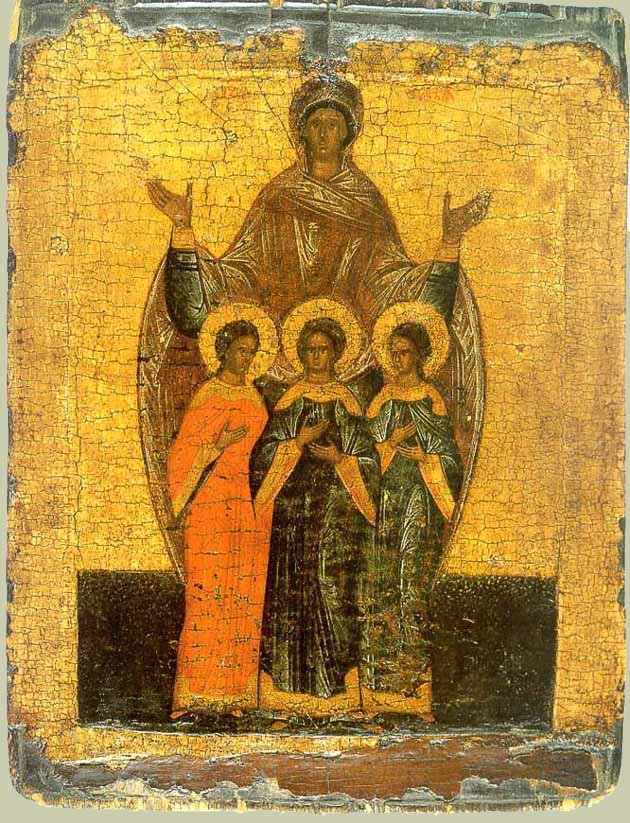
The emperor spared Sophia herself, thinking that grief would be worse for her than death. She took the bodies of her daughters, buried them outside the city and stayed by their grave for three days. On the third day she quietly died there, and the Christians laid her beside her daughters. That is why the Church venerates Sophia as a martyr: she suffered martyrdom not in her body but in her heart.
Historians note that their cult is attested in writing in Rome only from the 6th century, and that the details of the story took shape later. But the memory of a mother who went with her children to death without denying Christ has come down through the centuries to every Christian people.
From Rome to Alsace
The martyrs were buried outside the walls of Rome. According to tradition, in the 8th and 9th centuries, when relics were moved from the suburban cemeteries into the city churches, part of the martyrs’ relics went to the Roman basilica of San Martino ai Monti and part to the convent of Santa Giulia in Brescia.
The principal treasure went north. Around 770 Bishop Remigius (Rémi) of Strasbourg founded a Benedictine convent at Eschau, on an island among the branches of the Rhine. On a pilgrimage to Rome he received from Pope Adrian I a precious gift, “the most precious body of Saint Sophia”. On 10 May 777 the relics were solemnly welcomed at Eschau, and from then on the convent was known as the abbey of Saint Sophia. Her daughters have been venerated there alongside her since ancient times.
So the Roman martyrs became saints of Alsace — long before the separation of the Churches, when East and West confessed one faith. For Orthodox Christians in Western Europe this is one of the most moving shrines of the undivided Church.
Twelve centuries of Eschau
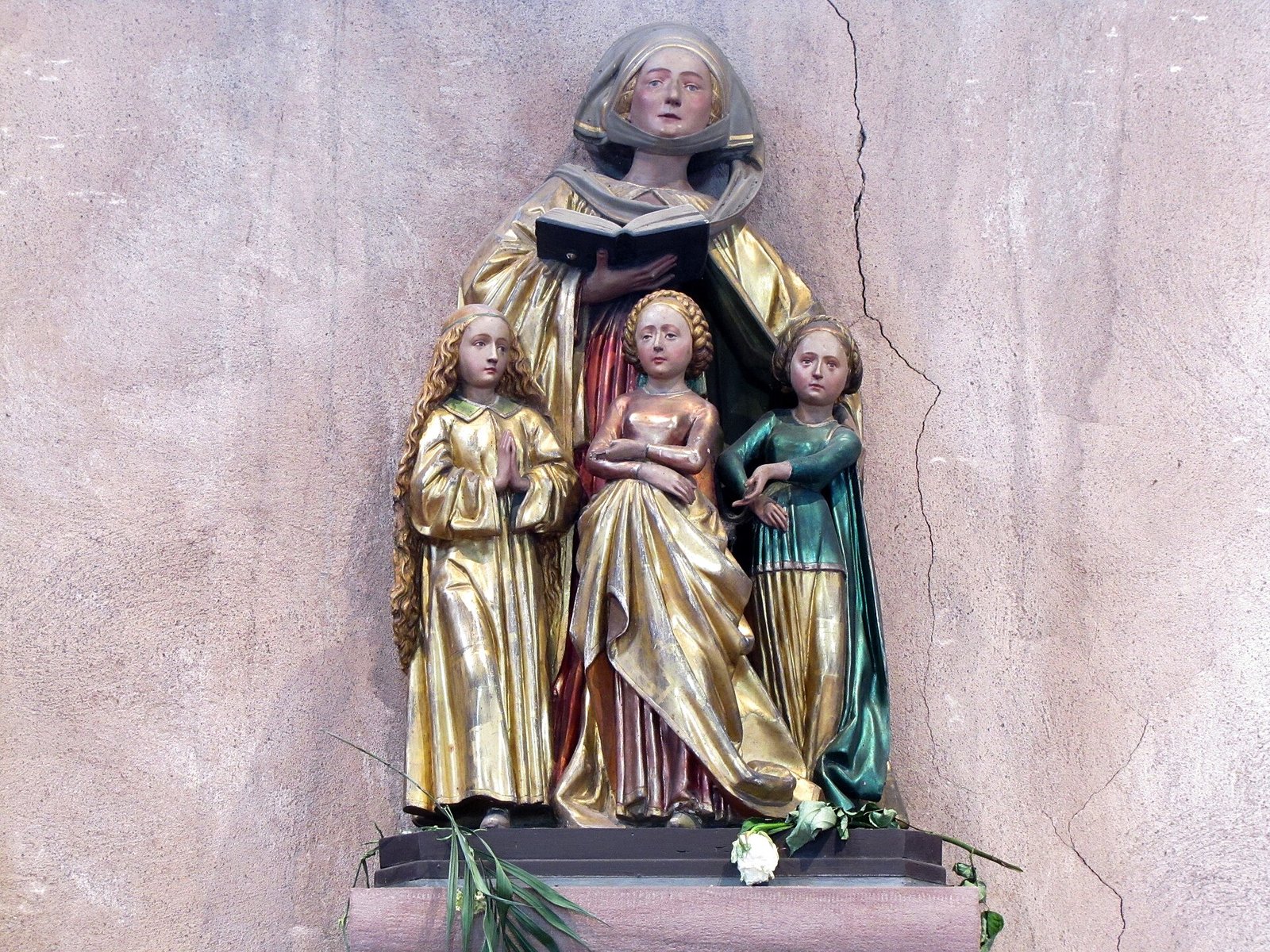
The abbey’s history was turbulent. In 926 the Hungarians sacked the monastery; at the end of the 10th century Bishop Widerold rebuilt the basilica — its walls survive to this day, and it is now one of the oldest Romanesque churches in Alsace. Around 1130 a cloister with carved capitals was added (fragments are kept in the Musée de l’Œuvre Notre-Dame in Strasbourg). Around 1350 a Gothic shrine was made for the relics, and around 1480 the carved group of Saint Sophia with her daughters.
In 1525, during the Peasants’ War and the Reformation, the monastic community broke up. In 1632, during the Thirty Years’ War, the church was plundered by Swedish troops, and in the French Revolution the monastic buildings were sold off as national property; in these troubled times the relics were scattered and largely lost. In the 20th century, fragments of the relics of Saint Sophia were placed once again in the ancient shrine (according to some sources, in 1938). The church has been a listed historic monument since 1898 and was restored in 2020–2022.

Orthodox pilgrims at Eschau
In recent decades Orthodox pilgrims have been coming back to the relics of Saint Sophia, warmly welcomed by the Catholic parish of Eschau and the town hall. In September 2013 great celebrations were held there for the martyrs’ feast: the services were led by Bishop Ambrose of Neftekamsk, and hundreds of pilgrims came from Russia, France, Germany, Britain and Switzerland. Since then the Orthodox parish of All Saints in Strasbourg has regularly celebrated services and molebens at the relics.
In October 2024 priests from several Orthodox parishes in Strasbourg and Metz celebrated the Divine Liturgy there, with a Byzantine choir from Thessaloniki singing. After the Liturgy the faithful venerated the relics, and the local Catholic priest invited everyone to a meal in the parish hall.
Visiting the relics
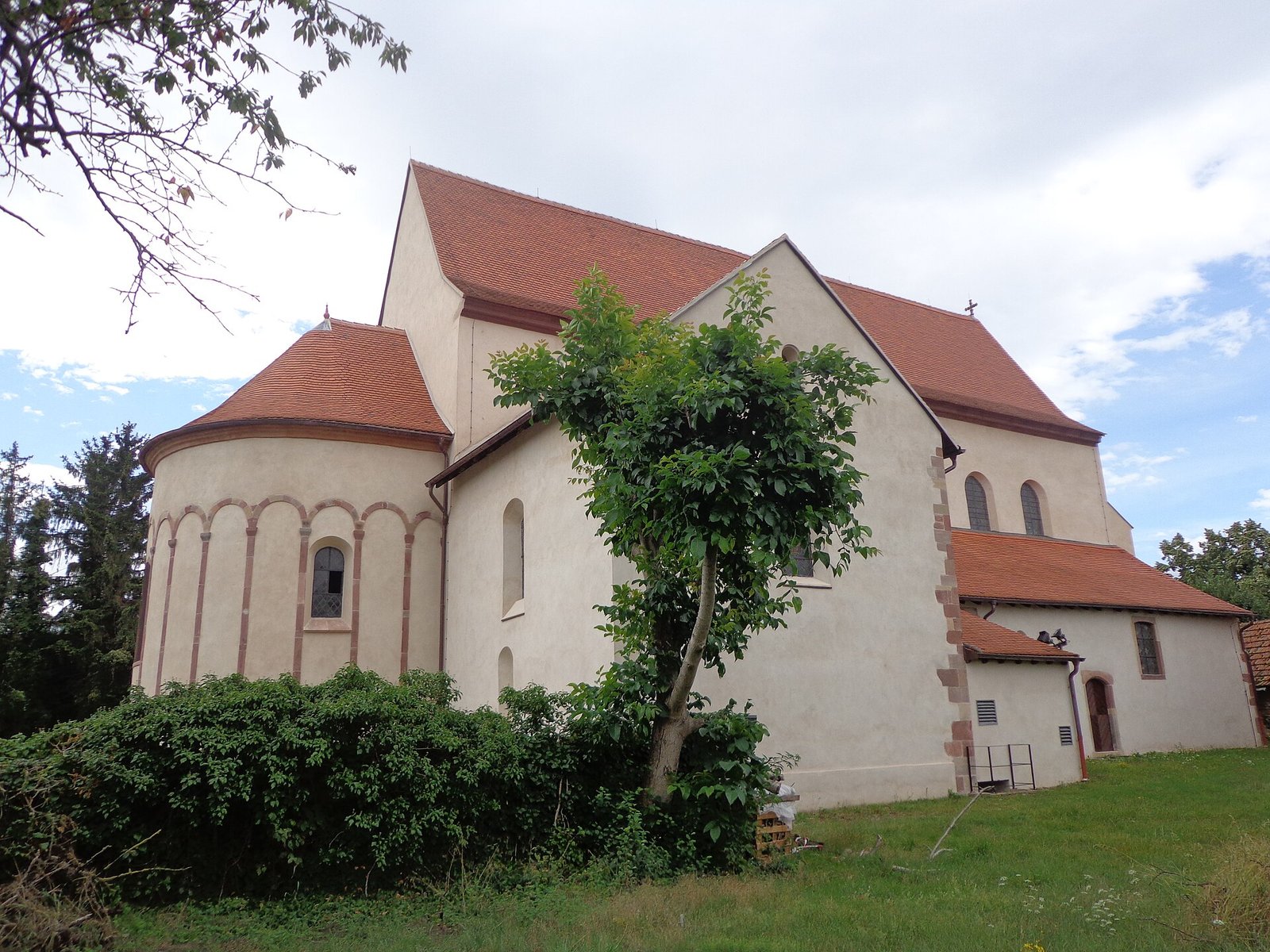
- Where: Abbatiale Saint-Trophime, rue de la Première Division Blindée, 67114 Eschau, France. The relics lie in the Gothic shrine in the chapel of Saint Sophia, beside the carved group of the martyrs.
- When: the church is open daily from 9:00 to 17:00, except during Catholic services.
- Getting there: Eschau lies about 8 km south of Strasbourg; bus no. 67 to the “Abbatiale” stop.
- Also worth seeing: the church also keeps a fragment of the True Cross; there is a monastic garden next to the church.
- A moleben at the relics: pilgrim groups can arrange a service through the Orthodox parish of All Saints in Strasbourg (106, rue du Général Conrad, 67000 Strasbourg; ruhramprojects@gmail.com, website ruhram.eu). Names for the moleben can also be sent through the parish website.
- Feasts: 30 September (17 September Old Calendar) and 10 May, the anniversary of the relics’ arrival at Eschau.
A pilgrimage to Eschau can easily be combined with a visit to Mont Sainte-Odile and the tomb of Saint Odile, patron saint of Alsace, listed in our directory of Orthodox holy sites in Europe. In Rome, the basilica of San Martino ai Monti is linked by tradition with another part of the saints’ relics.
Sophia and “Sophia”
The martyr Sophia should not be confused with the Wisdom of God — Hagia Sophia, to which the great cathedrals of Constantinople, Kyiv and Novgorod are dedicated: in the Church’s theology the Wisdom of God is above all Christ Himself, the Word of God. Yet there is an inner link between them. The mother who raised her children in faith, hope and love and did not deny Christ showed how divine Wisdom becomes a human life. It is this wisdom — living the faith in today’s Europe, on a land where the saints of the undivided Church rest — that our portal sets out to write about.
Sources: commune of Eschau; Federation of Historical Societies of Alsace; All Saints parish, Strasbourg (ruhram.eu); Pravoslavie.ru; Vicariat orthodoxe; Orthodoxie.com; Visit Strasbourg.